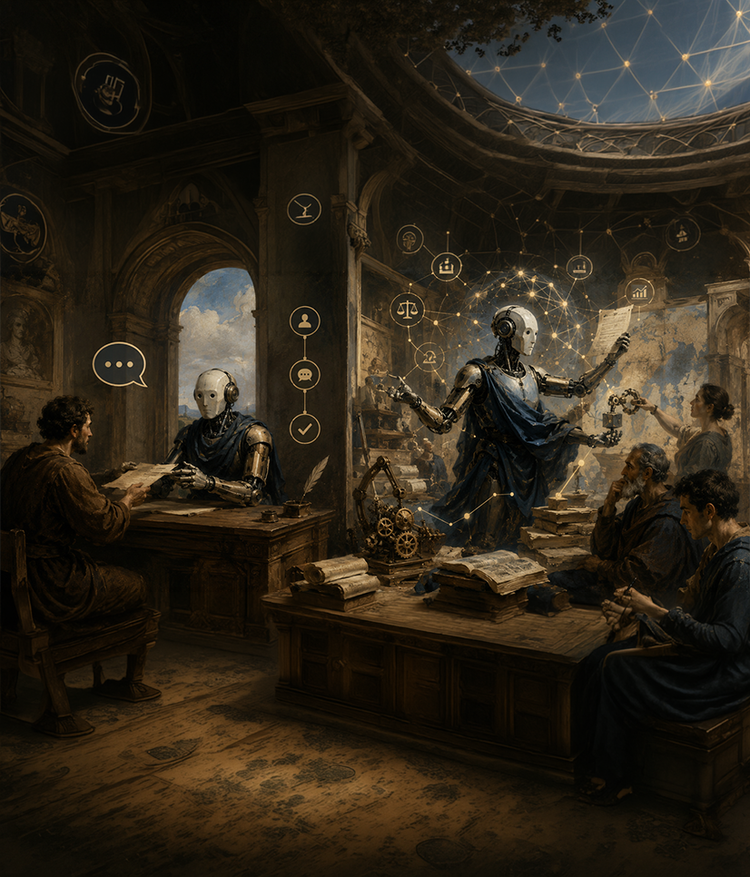
As artificial intelligence becomes increasingly integrated into business operations, two terms are often used interchangeably: AI agents and chatbots. While both technologies are designed to interact with users and automate tasks, they serve different purposes.
Understanding the differences between AI agents and chatbots is important for businesses looking to improve customer experiences, streamline operations, or implement intelligent automation. Although both rely on artificial intelligence, they differ significantly in terms of autonomy, decision-making capabilities, complexity, and real-world applications.
Understanding Chatbots
Chatbots are software applications designed to interact with users through text or voice conversations. Traditionally, chatbots have been used to answer frequently asked questions, guide customers through simple processes, and provide basic support.
Most chatbots operate within predefined boundaries. They identify user intent, match it to a response, and provide an answer based on scripted rules, templates, or natural language processing capabilities.
For example, an e-commerce chatbot may help customers track an order, check return policies, or answer common product-related questions. Once the interaction is complete, the chatbot waits for the next user prompt.
Chatbots excel at handling repetitive, predictable interactions efficiently and at scale.
Understanding AI Agents
AI agents represent a more advanced form of artificial intelligence. Rather than simply responding to prompts, AI agents can understand goals, plan actions, access tools, and execute multi-step tasks independently.
An AI agent can gather information from different sources, analyse data, make decisions, and perform actions without requiring constant human guidance.
For example, if a customer requests a refund, an AI agent could verify purchase records, check eligibility, initiate the refund process, update internal systems, and notify the customer, all as part of a single workflow.
This ability to reason, act, and adapt makes AI agents far more autonomous than traditional chatbots.
AI Agents vs Chatbots: Key Differences
The biggest difference between AI agents and chatbots lies in how they approach tasks.
Chatbots are reactive. They respond when a user asks a question and generally operate within a fixed set of rules.
AI agents are proactive. They can evaluate a situation, determine the steps required to achieve a goal, and carry out those actions across multiple systems.
Chatbots typically handle straightforward interactions such as answering FAQs, booking appointments, or providing status updates. AI agents are designed for more complex workflows involving decision-making, data analysis, and task execution.
Another distinction is their ability to learn and adapt. While traditional chatbots often require manual updates and retraining, AI agents can continuously improve their performance through feedback, machine learning, and contextual awareness.
The Technology Behind Them
Most chatbots rely on conversational interfaces, predefined workflows, and natural language processing to understand user requests.
When a customer asks a question, the chatbot identifies the intent and delivers a suitable response from its knowledge base or predefined rules.
AI agents, however, build on more advanced technologies. They often leverage large language models, memory systems, reasoning frameworks, and tool integrations.
Instead of simply answering a question, an AI agent can break down a task into smaller steps, access external databases, interact with software applications, and combine information from multiple sources before generating a response.
For instance, while a chatbot may answer a customer's query about product availability, an AI agent can check inventory levels, estimate delivery timelines, recommend alternatives, and place an order on the customer's behalf.
Where Chatbots Work Best
Chatbots remain highly effective for high-volume interactions where consistency and speed are important.
Common use cases include:
- Customer support FAQs
- Order tracking
- Appointment scheduling
- Lead qualification
- Basic troubleshooting
- Internal employee help desks
Because these tasks follow predictable patterns, chatbots provide a cost-effective solution for businesses looking to automate routine interactions.
Where AI Agents Deliver More Value
AI agents are better suited for situations that require reasoning, adaptability, and coordination across multiple systems.
They can assist with:
- Customer onboarding
- Claims and refund processing
- Technical support workflows
- Research and reporting
- Financial analysis
- Sales and customer success operations
- Cybersecurity monitoring
In these scenarios, the ability to analyse information, make decisions, and execute actions creates significantly greater value than a traditional chatbot can provide.
Advantages and Limitations
Both technologies offer benefits, but they also have limitations.
Chatbots are generally easier and less expensive to deploy. They require fewer computing resources and are highly effective for repetitive customer interactions. However, they often struggle with complex requests, ambiguous questions, or conversations that fall outside predefined scenarios.
AI agents offer greater flexibility and automation capabilities. They can manage sophisticated workflows and reduce manual effort across organisations. However, they require stronger governance, higher-quality data, and more advanced security controls. Their greater autonomy also introduces additional risks if outputs are not properly monitored.
As a result, AI agents often involve higher implementation costs and more extensive oversight compared to chatbots.
Should Businesses Choose AI Agents or Chatbots?
The answer depends on the complexity of the problem being solved.
If the objective is to automate simple customer interactions, answer frequently asked questions, or reduce support workloads, chatbots are often sufficient.
However, if a business needs technology that can analyse information, make decisions, coordinate workflows, and perform actions across multiple systems, AI agents are a more suitable choice.
Many organisations are now adopting a hybrid approach. Chatbots act as the first point of contact, handling straightforward requests, while more complex issues are escalated to AI agents that can complete end-to-end workflows.
This combination allows businesses to balance efficiency, cost, and automation capabilities.
The Future of AI Agents and Chatbots
The gap between AI agents and chatbots is likely to narrow over time. Modern chatbots are becoming more intelligent, while AI agents are becoming more accessible and easier to deploy.
As large language models continue to improve, businesses will increasingly use AI-powered systems that combine conversational interfaces with agentic capabilities. Users may interact through a chatbot interface, while AI agents operate behind the scenes to gather information, make decisions, and complete tasks.
Industries such as healthcare, finance, retail, and customer service are already exploring these models to improve efficiency and deliver more personalised experiences.
Wrapping Up
The debate around AI agents vs chatbots is not about determining which technology is better. Instead, it is about understanding which solution is best suited to a specific business need.
Chatbots excel at handling routine, repetitive interactions quickly and efficiently. AI agents go a step further by planning, reasoning, and executing complex tasks across multiple systems.
As organisations continue to embrace intelligent automation, both technologies will play an important role. The most successful implementations will be those that align the level of AI capability with the complexity of the task, ensuring a better experience for both businesses and users.